

Introduction
As global cities accelerate environmental governance and pursue higher efficiency in sanitation operations, a new round of pavement maintenance technology innovation is gradually emerging. Over the past year, the adoption rate of National VI emission standard Road Surface Maintenance Trucks has significantly increased in multiple provinces in China and overseas municipal markets, marking a transformation of urban operations towards cleaner, smarter, and more standardized directions.
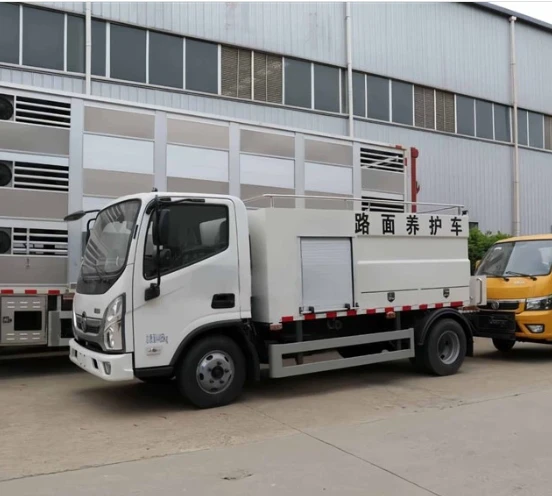
According to data from multiple municipal engineering departments, the latest generation of National VI Road Surface Maintenance Trucks has achieved quantifiable improvements in water conservation performance, fuel economy, and pavement cleaning accuracy. These advancements are highly consistent with the sustainability targets prioritized by many local governments in their 2030 environmental roadmaps.
Industry analysts point out that this trend is mainly driven by three core factors: emission compliance, rising urban population density, and the aging of urban roads. In old urban areas where traffic flow has accumulated over decades, road dust, sediment buildup, and surface oil residues pose major challenges for daily management. For this reason, upgraded equipment (such as Advanced National VI Road Surface Maintenance Trucks for Urban Cleaning) is increasingly being adopted. These vehicles not only have high-pressure flushing capabilities but also reduce environmental impact.
Professional analysis
Experts emphasize that National VI engines that meet stricter combustion and exhaust standards have significant long-term value. Emission reduction studies by several transportation laboratories in East Asia have shown that high-efficiency sanitation vehicles equipped with upgraded powertrains can reduce particulate emissions by more than 40% compared to older Euro III-V fleets. This finding is particularly important for densely populated regions, where road dust is one of the main causes of declining air quality.
Another notable trend is the integrated application of refined cleaning systems. The latest upgraded National VI road surface maintenance truck for city operation is usually equipped with imported high-pressure pumps, intelligent flow control and multifunction spray systems, which can adapt to different road surface materials and contamination levels. Engineers say that multi-speed flushing, adjustable spray width and independent auxiliary engines are no longer "high-end configurations", but are rapidly becoming standard requirements in municipal bidding documents.
The urban development model is also influencing procurement decisions. With more pedestrian zones, commercial hubs and shared mobility routes added each year, the environmental sanitation department has put forward higher requirements for the operational flexibility of equipment. The High-Efficiency National VI Road Surface Maintenance Truck dedicated to Municipal Service has launched pilot programs in several medium-sized cities. Early feedback shows that it has faster deployment speeds, better maneuverability in narrow alleys, and significantly lower nighttime noise levels - a feature that is particularly well-received in residential areas.
International buyers are also getting involved. Many cities in Southeast Asia and the Middle East have initiated the transformation from manual or low-pressure cleaning to mechanized flushing systems. Analysts predict that by 2028, the market for road washing trucks, pavement flushing vehicles and street-cleaning maintenance units will grow steadily, with core considerations including water resource efficiency, pump durability and compliance with increasingly strict global emission frameworks.
Summary
Although the technology is still evolving, analysts remind the industry to simultaneously address challenges such as parts compatibility, training for new operators and the long-term cost-effectiveness of high-pressure equipment. However, most experts believe that the popularization of National VI Road Surface Maintenance Trucks marks a decisive step towards cleaner, more sustainable and data-driven urban sanitation management. As cities continue to refine their public service strategies, this sector is expected to witness further innovations in real-time monitoring, eco-friendly water reuse systems and intelligent cleaning route planning. Currently, the increasing popularity of National VI standard vehicles has sent a clear signal that the future of road surface maintenance is moving towards higher standards, lower emissions and smarter municipal operations.