


Introduction
Cities around the world are increasingly congested and people's environmental awareness is increasing. Against this background, electric home tricycles have practical, economical and sustainable characteristics, making them a new option for urban mobility. Once a niche means of transportation in developing markets, it is now transforming the way families, communities and small businesses navigate cities. Its increasing popularity shows a remarkable trend of people saving energy and localization.
Why are electric tricycles attracting so much attention?
Behind the development of the household electric tricycle is the global pursuit of a more concise and environmentally friendly means of transportation. Unlike traditional vehicles that rely on expensive fuels and complex mechanical systems, tricycles are powered by clean electrical energy, which lowers the cost of use and reduces emissions.
Adapting to short-distance demand: in regions where short-distance travel is the dominant, such as southeast Asia, Africa and Latin America, it has become the first choice for family feet, transfers of children to and from school, and even small logistics transport.
Policy support: incentive policies such as government subsidies, tax incentives, lower registration fees, and stricter emissions regulations are also driving this trend. For middle-income families, economically viable electric tricycles are a great entry point for them to enter the field of sustainable travel.
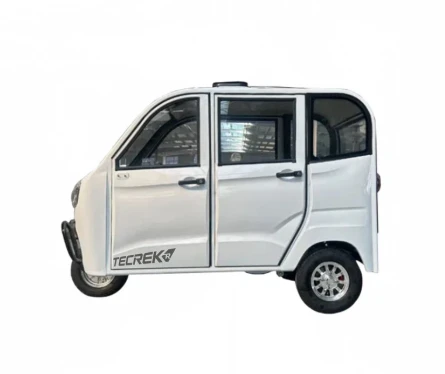
Design evolution and technological innovation.
The modern electric home tricycle has already surpassed its initial model, and manufacturers have made significant improvements in battery technology, powertrain efficiency and structural design.
Core specification improvements: most current models are equipped with a brushless dc motor with a power output of 800W to 1500W, providing a stable range of 60 to 80 km on a single charge.
Breakthroughs in battery technology: the application of lithium-ion batteries is an important milestone. They are lighter and have a longer life than conventional lead-acid batteries, and are capable of rapid charging. Combining this with a smart controller and a regenerative braking system can further optimize energy consumption and extend the life of the entire vehicle.
Practical recognition: closed cockpit, reinforced chassis and multi-seat design, complete short family trips instead of small cars; The compact body makes it easy to navigate narrow roads, which is a major advantage in densely populated urban areas.
To address sustainable urban issues.
Urban planners are increasingly aware of the role of electric tricycles in alleviating traffic congestion and reducing emissions. Faced with the challenge of balancing population growth and traffic demand, electric tricycles fill the gap between two-wheeled vehicles and large electric vehicles, and because of their low energy consumption, the ideal choice for smart cities to promote a "zero emission" policy. It's going to be.
At the same time, the electric tricycle has also contributed to the development of Shared driving and micro-transportation. In many communities, the system has already been used for access to neighborhoods, community care, and student transportation, contributing not only to personal convenience, but also to the realization of sustainable social and environmental goals.
Market trends and global expansion.
The electric tricycle business is expanding rapidly according to the global mobile market report, sales of household electric tricycles are expected to grow by more than 7% annually by 2030. China is still the world's largest production base, supplying large quantities of products to Asia, Africa and Europe. In Europe and the United States, demand for these products has been growing steadily, as consumers with high environmental awareness have accepted them.
For wholesale importers, the sector is profitable and stable in the long term. Low maintenance costs, easy assembly, and flexible customization make electric tricycles a strategic product for emerging electric car dealers. In a market where there is no infrastructure for large electric cars, tricycles are filling an important gap.
The challenges we're facing and where we're going.
Despite its advantages, electric tricycles face all business challenges. Battery recovery, standardization of parts, and differences in laws and regulations still limit its rapid development. In addition, many countries lack road regulations specifically for tricycles, resulting in inconsistencies in licensing and safety standards.
However, technological innovation and global cooperation are helping to solve these problems. As more and more countries have clear electric car policies, electric home tricycles are expected to be approved by the government and become a legal means of urban transportation. . At the same time, the application of renewable energy in the field of power generation is becoming more and more widespread, which makes the advantages of electric tricycle environmental protection stand out.
In conclusion
As the transition to sustainable mobility accelerates, electric home tricycles combine economics, innovation and eco-responsibility. It reflects not only the convenience of transportation, but also the changing priorities of society in which families seek safer, cleaner and more economical means of transportation.
Advancements in battery technology and the adaptation of urban infrastructure are expected to make home electric tricycles a core option for short-distance travel. For governments, businesses and consumers, these vehicles are a solid step towards realizing the vision of "greener cities" and "smarter transportation networks."