


Introduction
Concrete transportation is a critical link in the global construction supply chain. As urbanization accelerates and infrastructure projects expand, the demand for efficient, stable, and reliable concrete delivery equipment continues to grow. Among all vehicle configurations, the 6x4 Concrete Mixer Truck has become one of the most commonly used models across developing and developed markets. This article explains the technology, trends, safety, and engineering principles behind modern mixer trucks-helping readers understand why certain designs dominate today's industry.
1. Why Concrete Transportation Technology Matters
Concrete begins losing slump within minutes after mixing. Studies from multiple civil engineering institutes show that concrete can lose 15–20% of its plasticity within the first hour if not properly agitated. This is why mixer trucks are not merely vehicles-they are mobile concrete preservation systems.
The professional 6x4 Concrete Mixer Truck model is widely adopted because its drivetrain layout provides the stability needed to transport heavy rotating drums while maintaining constant mixing motion.
Key factors affecting concrete quality during transport include:
Drum rotation speed stability
Hydraulic system torque consistency
Temperature and environmental exposure
Vehicle maneuverability on uneven terrain
Understanding these factors helps explain the engineering choices behind modern mixer truck design.
2. Why the 6x4 Configuration Became a Global Standard
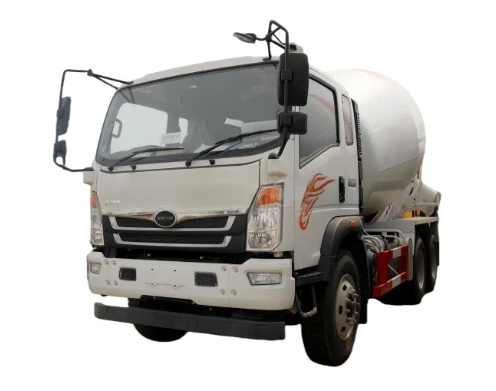
A 6x4 Concrete Mixer Truck for construction uses one steering axle and two powered rear axles. This layout improves traction, load distribution, and slope performance.
Technical advantages of 6x4 configuration:
Higher traction: Two driving axles can increase power transfer to the ground by up to 25% on rough surfaces.
Better stability: The extra axle helps balance the heavy drum and shifting liquid load.
Improved durability: Stress is shared across more axles, reducing wear on suspension and driveline parts.
Optimized for 5–8 m³ drums: The most commonly requested capacity for global mid-sized construction projects.
These advantages explain why the heavy-duty 6x4 Concrete Mixer Truck remains the mainstream choice in Asia, Africa, South America, and the Middle East.
3. How Mixing Drums Maintain Concrete Quality
Although drum design differs among manufacturers, the core engineering principles remain similar. Inside the drum, spiral blades lift, fold, and push concrete to maintain uniformity.
Key performance indicators include:
Mixing capacity: Common ranges are 5.5–7 m³ for 6x4 models.
Drum thickness: High-strength steel reduces wear from aggregates.
Rotation speed: Usually 0–16 rpm for mixing, 0–12 rpm for discharge.
Slump retention efficiency: A measure of how well the drum preserves workability.
Modern drums use optimized blade angles to minimize aggregate separation. This supports consistent slump, which is crucial for structural integrity during concrete pouring.
4. Hydraulic Systems: The Heart of Mixer Truck Operation
Hydraulics power the drum's rotation, making them one of the most important systems in any mixer truck. A typical hydraulic assembly includes:
Oil pump
Motor
Reducer
Cooling system
High-efficiency hydraulic components can operate for 8,000–10,000 hours before major servicing. This is one reason contractors and wholesalers often choose a bulk-order 6x4 Concrete Mixer Truck-it offers cost stability and predictable maintenance cycles.
5. Safety Engineering in Modern Mixer Trucks
Concrete mixer trucks operate under demanding conditions, carrying loads with shifting mass. Safety design has therefore become a major engineering focus.
Industry-recognized safety measures include:
Air braking systems for fast stopping distance
Reinforced rear underrun protection
Anti-overflow drum openings
Low-center-of-gravity drum positioning
Cab visibility optimization
These systems are essential for minimizing risks in confined construction sites, steep roads, or urban traffic.
6. Environmental Standards and Global Regulations
Environmental requirements are reshaping heavy equipment design. Many regions now require:
Euro V / National V emissions
Noise reduction measures
Fuel efficiency improvements
Sustainable production footprints
This regulatory shift motivates manufacturers to optimize engines, reduce fuel consumption, and adopt cleaner combustion technologies. The 6x4 Concrete Mixer Truck configuration aligns well with many of these updated requirements due to its balanced design and compatibility with efficient diesel engines.
7. Industry Trends: Digitalization and Smart Monitoring
The mixer truck industry is gradually adopting digital technologies:
GPS fleet tracking
Real-time drum rotation monitoring
Concrete slump sensors
Fuel consumption data logging
Predictive maintenance alerts
These advancements help construction companies reduce waste, prevent delays, and extend equipment lifespan.
Conclusion: Why Understanding Mixer Technology Matters
Concrete is the foundation of global infrastructure, and mixer trucks are the backbone of its movement. From drum design to hydraulic performance and axle configuration, every component of a 6x4 Concrete Mixer Truck is engineered for reliability, safety, and efficient concrete preservation.
Whether readers work in engineering, logistics, procurement, or construction management, understanding the science behind these machines provides valuable insight into how modern building projects maintain quality and speed.