


Why Cities Need Smarter Transport Solutions
Have you ever wondered why delivery trucks in many cities are getting smaller?
The answer lies in the changing landscape of urban logistics. Congested streets, environmental policies, and rising fuel costs are forcing transport companies to rethink how goods move through cities. Large diesel trucks are often impractical for short-distance deliveries and narrow streets.
This shift has given rise to a new segment of light commercial vehicles - the mini flatbed truck for sale. These compact workhorses, once seen as niche vehicles, are now becoming central to the logistics revolution. But what makes them so effective, and why are they increasingly powered by electricity?
The Technological Turning Point
Electric technology has reached a point where size no longer limits power. The modern electric mini flatbed truck for sale is built around efficiency and sustainability, combining strong performance with lower operating costs.
Manufacturers are now using lithium iron phosphate (LFP) batteries, such as those from CATL, which provide excellent safety, long lifespan, and stability. These batteries allow mini trucks to achieve ranges of 200–230 km on a single charge-enough for most daily urban logistics operations.
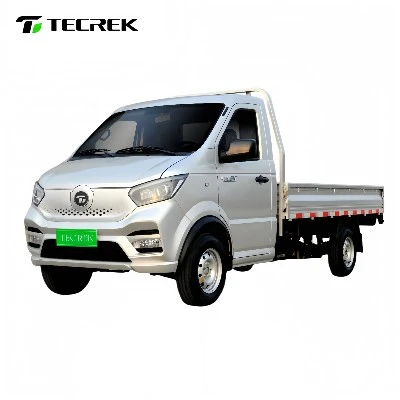
It's no coincidence that the 1.5 ton mini flatbed truck has become a popular model in cities across Asia and Europe. Its combination of payload capacity, compact dimensions, and zero-emission powertrain makes it an ideal solution for everything from parcel delivery to light construction support.
Can Smaller Really Mean Smarter?
Some might ask: can a small truck truly handle the workload of a full-size vehicle? The answer depends on what "workload" means in the modern logistics world.
In dense urban areas, what limits delivery efficiency isn't power-it's access. Large vehicles often waste time navigating traffic or searching for space to park. A mini electric flatbed truck for logistics can enter tighter roads, make more stops per hour, and reduce idle time, resulting in greater overall productivity.
In fact, many fleet operators report that replacing a few large diesel trucks with several smaller electric ones not only cuts emissions but also improves delivery speed and reduces operational costs.
Economics Behind the Trend
Let's talk about numbers. The total cost of ownership is a key factor for logistics companies. When comparing diesel to electric options, the difference is striking.
An electric mini flatbed truck can reduce running costs by up to 60% over its lifetime. There's no engine oil to replace, no exhaust system to maintain, and fewer mechanical parts that wear out. Electricity is cheaper and more stable in price than fossil fuels, and regenerative braking helps extend both battery and brake life.
For wholesale buyers, these advantages are not just environmental-they're financial. Lower maintenance and energy costs mean faster payback and higher profit margins. Governments in many countries are further supporting this shift with green subsidies and tax incentives for zero-emission vehicles.
What's Driving Global Adoption?
The rise of e-commerce and "on-demand" delivery is reshaping logistics. More deliveries, smaller batches, and shorter routes are now the norm. Fleet managers need vehicles that can make frequent trips without downtime or excessive fuel consumption.
The CATL-powered mini flatbed truck fits perfectly into this new rhythm. It's strong enough to carry 1.5 tons of goods, yet agile enough for last-mile delivery. With compact dimensions around 6 meters long, it fits comfortably into urban parking spaces while maintaining the power to handle industrial tasks.
It's not surprising that logistics hubs, construction sites, and municipal service fleets are rapidly adopting this format. In cities aiming to reduce noise and air pollution, electric mini trucks are being prioritized over larger diesel vehicles.
How Policy and Technology Work Together
Many governments are making it clear: the future of logistics must be electric. In Europe, China, and parts of the Middle East, low-emission zones are already restricting diesel trucks. As policies tighten, companies are turning toward mini flatbed trucks for sale that meet emission-free requirements without sacrificing capability.
Battery makers and manufacturers like TECREK are responding by investing in R&D-improving range, battery durability, and charging infrastructure. CATL's LFP battery packs, for example, can last for thousands of cycles with minimal degradation, providing years of reliable service for commercial fleets.
What Does the Future Look Like?
Will all delivery fleets eventually go electric?
Most experts believe so. However, the real question is which vehicle size will dominate the market. The trend suggests that smaller, more agile, and more efficient electric vehicles will take the lead in urban centers, while larger electric trucks serve intercity transport.
The mini electric flatbed truck for logistics bridges that gap perfectly-big enough to handle serious loads, yet compact enough to move efficiently through city streets. Its versatility means it can serve as a municipal utility vehicle today and a delivery truck tomorrow.
Conclusion
The global logistics system is being redesigned from the ground up. As companies balance speed, cost, and sustainability, vehicles like the TECREK mini flatbed truck for sale are proving that small can indeed be powerful.
When we think about the future of transport, it's not just about electrification-it's about smart adaptation. Compact electric trucks embody that change. They show that logistics efficiency is no longer measured by engine size, but by how intelligently we move goods through our cities.