


With the continuous increase in urban population density and the deepening of population aging, traditional travel solutions are no longer able to meet the needs of people with mobility impairments. Among them, the many travel difficulties faced by wheelchair users on a daily basis are difficult to solve by ordinary electric scooters, tricycles or modified cars. This market gap has driven the rise of a new category - electric accessible mobility vehicles.
These compact wheelchair-compatible electric vehicles are rapidly becoming a practical, dignified and scalable urban travel solution.
Shortcomings of traditional travel solutions
For decades, the travel methods of wheelchair users have mainly relied on three tools, each with obvious limitations:
Manual wheelchairs require high physical strength from the user and are not suitable for long-distance travel;
Electric scooters have weak resistance to bad weather, poor safety when driving in traffic, and insufficient vehicle stability;
Modified cars have high purchase and maintenance costs, and their large size makes them difficult to adapt to the narrow roads in cities.
Nowadays, urban transportation infrastructure is developing towards low-speed traffic zones and short-distance travel within communities, and none of the above three travel tools can fully meet people's daily travel needs.
What is an electric disability assistance vehicles?
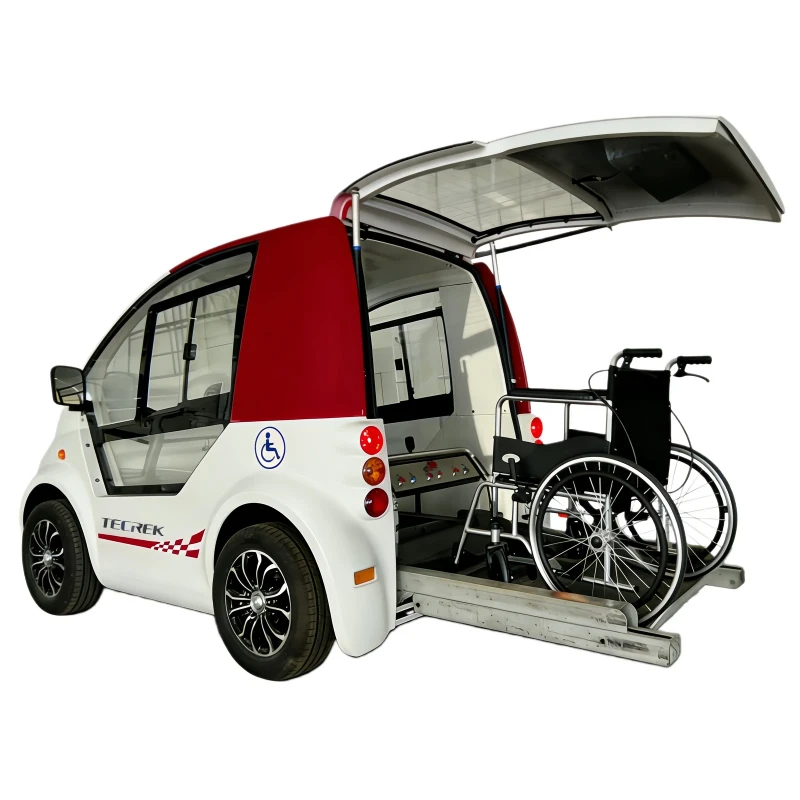
An electric disability assistance vehicles is a small low-speed electric vehicle designed specifically for wheelchair users. Its accessible design is not an afterthought or retrofit, but a core design concept integrated from the very beginning of vehicle development.
Its core features include:
Equipped with a dedicated wheelchair access channel at the rear or side, allowing users to get on and off the vehicle directly in their wheelchairs;
Fitted with an automatic lift or ramp, eliminating the need for manual wheelchair transfer;
Adopting a fully enclosed cabin structure, providing all-weather travel protection;
Equipped with a low-speed electric drive system, perfectly adapted to urban roads and community conditions.
This vehicle type lies between electric scooters and traditional cars, combining the advantages of both while eliminating their usage limitations.
The core value of the wheelchair direct entry design
The most crucial innovation of this category lies in the wheelchair direct entry design for getting on and off the vehicle. Traditional travel solutions often require users to transfer from their wheelchairs to car seats, which not only reduces travel autonomy but also increases safety risks.
In contrast, wheelchair-compatible electric vehicles enable users to:
Get on and off the vehicle independently from the rear without assistance;
Remain in their wheelchairs throughout the journey;
Secure the wheelchair with built-in fixtures to ensure driving safety.
This design significantly enhances users' travel autonomy, dignity, and daily convenience - three elements often overlooked in the development of traditional transportation.
The positioning of low-speed electric vehicles in urban traffic
Currently, urban travel policies worldwide are gradually tilting towards low-speed electric disability assistance vehicles. Speed limits, exhaust emission controls, and pedestrian priority zones have become standard measures in urban traffic management.
Electric accessible mobility vehicles naturally align with this policy direction:
A speed of approximately 25 kilometers per hour fully complies with the traffic regulations of community roads;
Their compact size effectively alleviates urban traffic congestion and parking pressure;
The electric drive system significantly reduces vehicle operating costs and maintenance requirements.
For wheelchair users, this means they can integrate more safely into urban traffic, avoiding the potential risks of driving large vehicles.
Safety and stability: The core transformation direction of the industry
Early assistive travel tools often sacrificed vehicle stability in pursuit of simple structures. Modern electric accessible mobility vehicles, however, are built to automotive engineering standards, with core configurations including:
A front-engine, front-wheel drive layout to ensure stable and predictable vehicle handling;
Dual disc brake systems at the front and rear to enhance braking response and effectiveness. Independent suspension structure, optimizing driving and riding comfort.
These configurations indicate that the industry is transitioning from "auxiliary travel devices" to truly electric vehicles designed specifically for people with disabilities, completely breaking away from the positioning of "modified alternatives".
Core beneficiary groups of electric disability assistance vehicles
The application groups of this model are continuously expanding, mainly covering the following categories:
Individual users who pursue independent daily travel;
Community elderly care institutions and residential facilities that serve the elderly or people with disabilities;
Municipal departments and social welfare projects dedicated to promoting inclusive transportation;
Dealers and distributors targeting the professional electric mobility market.
As global accessibility standards continue to rise, market demand is gradually expanding from niche application scenarios to standardized government procurement and commercial distribution channels.
Future outlook: From niche products to standardized mobility solutions
Industry development trends show that electric accessible mobility vehicles will continue to upgrade in three major directions:
Higher standardization to meet relevant regulations in international markets;
More advanced battery technology to extend battery life and range;
Modular design concepts that can be flexibly customized according to different user needs.
Manufacturers with the ability to develop entire vehicles and automotive-level production qualifications will dominate this transformation from "niche products to mainstream urban mobility solutions".
Conclusion
Electrically-powered mobility scooters for the disabled are by no means a simple extension of ordinary electric vehicles; they fundamentally reconfigure the interaction mode between wheelchair users and the urban environment. By integrating barrier-free design, safety features and small-scale electric drive technology, they effectively address the practical challenges that traditional travel solutions have been unable to overcome.
In the process of cities' transformation towards inclusive and sustainable transportation, electric wheelchairs are no longer an option but an indispensable part of the urban transportation system.