


As global urban density continues to increase and traffic volumes reach new highs, municipal authorities are under growing pressure to ensure clean, dust-free and safe roads. In many regions, the shift towards more advanced cleaning technologies has led to a significant increase in the application of High Pressure Road Cleaning Trucks - a specialized vehicle designed to address the urban environmental hygiene challenges that traditional sweepers can no longer meet.
Urban Dust: An Increasingly Severe Challenge for Modern Cities
Environmental studies in multiple regions have shown that road dust is a major source of PM10 and PM2.5 pollutants in cities. For instance, the 2024 Southeast Asian Urban Traffic Report indicates that in busy traffic areas, over 28% of particulate matter comes from road dust disturbed by vehicle movement. This not only causes air quality problems but also exacerbates corrosion around roads.
Cities that once relied on simple water trucks or basic sweepers now need a more powerful tool - one capable of removing compacted dirt, spilled chemicals, and oil residues through high-pressure flushing. The High Pressure Road Cleaning Truck is beginning to transform municipal cleaning strategies.
Why High-Pressure Technology is Replacing Traditional Road Cleaning Methods
Traditional sweepers operate like brooms: they can only move dust but often fail to remove deep-seated dirt accumulated in cracks and road corners. The working principle of high-pressure washing systems is different - it's like a precise water "knife" that cuts through dirt and washes it away with controlled pressure.
This is why municipal high-pressure road cleaning trucks are becoming increasingly popular in major cities like Kuala Lumpur, Riyadh, and Bogotá. Officials say that compared to mechanical sweeping alone, high-pressure flushing can reduce accumulated dirt by more than 40%.
A municipal manager in South Asia used a simple analogy to describe the difference: "Sweepers are like wiping a counter with a dry cloth; high-pressure washers are like rinsing with a strong stream of water - they can truly remove dirt that shouldn't be there."
The Technological Backing of Modern Cleaning Fleets
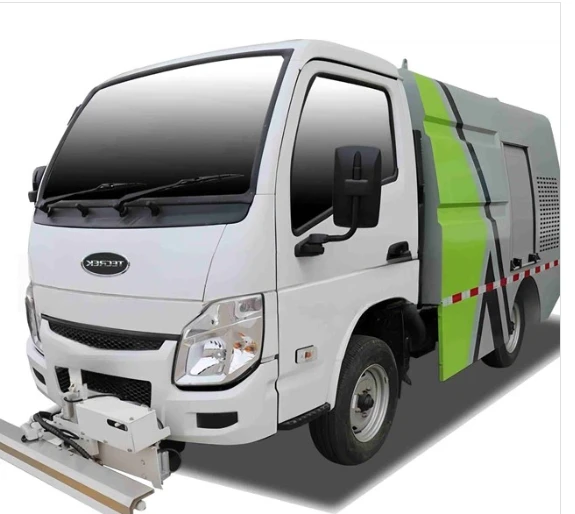
Modern cities require multi-system cleaning capabilities, and the marketized High Pressure Road Cleaning Truck offers this advantage. Many models today feature stainless steel water tanks to resist corrosion, are equipped with German-made high-pressure pumps to ensure a stable water flow, and come with advanced control systems that allow operators to adjust the spray mode according to different environments.
A typical high-pressure cleaning system includes:
Front-mounted spray bars for wide-range flushing
Precision side nozzles for sidewalks and curbs
Long-range water guns for targeted cleaning of tunnel walls or traffic barriers
Hose reels that can extend up to 15 meters for detailed work in narrow alleys
These configurations give it the flexibility of a multi-tool, allowing operators to switch between various cleaning tasks without changing equipment.
Rapid Growth in Developing Regions
Although high-income countries began using such vehicles years ago, the most rapid growth is currently seen in middle-income regions. Local governments are increasingly inclined to choose practical models such as compact high pressure road cleaning trucks, especially in downtown areas with limited road widths. For instance, the health department of a certain region in East Africa recently replaced 60% of its old water trucks with compact high-pressure cleaning equipment. Its internal report shows that within the first 90 days, road cleanliness improved by 33%, and maintenance costs also decreased due to fewer mechanical failures.
A similar trend is emerging in Latin America, where several medium-sized cities have adopted such vehicles to clean market areas, bus terminals, and commercial streets - places that often accumulate a lot of oil and dirt.
Market Trends: From Procurement to Policy
Governments around the world have now included high-pressure washing functions in their procurement specifications. Bidding documents typically specify hard requirements such as PSI output pressure, spray width, auxiliary engine type, and water tank material - standards that only modern advanced high pressure road cleaning trucks can meet.
The private sector is also driving demand growth. Logistics parks, highway concessionaires, and airport operators are increasingly inclined to purchase their own equipment rather than rely on outsourced services. These institutions usually look for high pressure road cleaning trucks for sale that have reliable daily operation capabilities, simple maintenance processes, and comply with environmental regulations.
Environmental Impact and Water Conservation Efficiency
A common misconception is that high-pressure systems waste water. In fact, studies show the opposite. Because high-pressure water flow can more efficiently remove dirt, compared to low-pressure water trucks, the water consumption per kilometer of road cleaned is usually reduced by 30% to 50%.
Environmental engineers use car washing as an analogy: "Using a garden hose to rinse may wet everything, but it's slow and wasteful; using a high-pressure washer cleans faster and uses less water." Cities that have adopted high pressure road cleaning trucks have also reported similar efficiency improvements.
Future Outlook: Smart Cleaning Integration
The next wave of development is digitalization. Manufacturers are currently integrating GPS-connected cleaning maps, water flow sensors, and predictive maintenance algorithms into the equipment. Several pilot cities in Europe are testing artificial intelligence-assisted control systems that can automatically adjust nozzle pressure based on detected dirt density.
Analysts predict that high-pressure road cleaning technology will continue to gain popularity in Southeast Asia, the Middle East, Africa, and India - regions that are experiencing rapid urbanization and increasingly strict environmental regulations.
Conclusion
As urban environmental hygiene demands rise and cities seek more effective solutions, high pressure road cleaning trucks have become a core tool in modern road management fleets. Their ability to remove deep dirt, operate efficiently in narrow spaces, and clean with low water consumption makes them increasingly attractive to both municipal departments and private operators. Whether as municipal high pressure road cleaning trucks, compact high pressure road cleaning trucks, or high pressure road cleaning trucks for sale, this technology is reshaping the way cities maintain clean and healthy public environments.