


Introduction
In recent years, the high-altitude maintenance industry has undergone significant changes, and the core of this transformation is the 32 meter foldable arm high-altitude work platform vehicle - this professional equipment is rapidly becoming the benchmark in the high-altitude work field. With the surge in demand for safe and efficient high-altitude work, foldable arm high-altitude work platform vehicles and similar equipment (foldable arm high-altitude work platform vehicles) are increasingly being used in the construction, power, and municipal sectors.
Market Momentum and Growth Drivers
According to industry research, the global high-altitude work platform vehicle market is expected to grow steadily. A report predicts that the market size of high-altitude work platform vehicles will increase from 12.82 billion US dollars in 2023 to 20.42 billion US dollars in 2029, with a compound annual growth rate (CAGR) of approximately 7.9% (Source: Research and Markets). Another analysis of the vehicle-mounted high-altitude work platform market shows that the market is expected to grow by 1.64 billion US dollars between 2023 and 2028, with a CAGR of approximately 6.06% (Source: Technavio).
In this context, equipment like the 32-meter high-altitude work platform vehicle is particularly significant - its ultra-long working radius can meet increasingly complex infrastructure operation requirements, including smart city lighting, communication towers, and high-rise building facade maintenance.
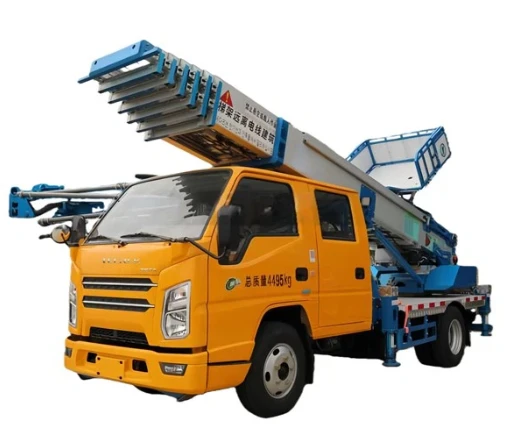
Technical Evolution: Why Foldable Arms Are Crucial
Traditional high-altitude work methods (ladders, scaffolding, fixed-arm elevators) have limitations in terms of working height, maneuverability, and safety. In contrast, high-altitude work platform vehicles with foldable arms significantly enhance operational flexibility. The 32 meter foldable arm high-altitude work platform vehicle has a maximum working height of 32 meters and is suitable for tasks such as high-pole lamp installation, power line maintenance, and high-rise building facade cleaning.
In addition, modern equipment also integrates automatic leveling systems, 360-degree rotating work buckets, remote control, and advanced safety interlock devices. As a technical review points out: "The development prospects of high-altitude work platform vehicles are 'broad... The technologies adopted are constantly advancing, and safety, efficiency, and overall performance have all been improved" (Source: jcs-hoisting.com).
For fleet managers and leasing companies, the production efficiency improvement and risk reduction brought by foldable arm high-altitude work platform vehicles make them strategic assets in the high-altitude work field.
Core Applications and Industry Requirements
The demand for 32-meter high-altitude work platform vehicles is particularly strong in the following application areas:
Communication and Power Industry: The accelerated deployment of 5G and fiber optic networks, and high-voltage power maintenance, require high requirements for equipment's working height and safety stability - the 32-meter foldable arm design precisely meets these needs.
Municipal Services: Maintenance of streetlights, traffic signal lights, and urban greening work, increasingly requires high-altitude work platforms that can safely reach power poles and high-rise facilities.
Construction and Facade Engineering: As building heights increase and facade forms become more complex, foldable arm high-altitude work platform vehicles can achieve efficient work without building scaffolding (saving time and cost).
These trends also highlight why 32-meter foldable arm high-altitude work platform vehicles and similar equipment (foldable arm high-altitude work platform vehicles, folding-arm high-altitude work platform vehicles) are becoming core members of contractors' equipment portfolios.
Safety, Regulations, and Rental Applications
Safety regulations play a key role in promoting the popularization of high-altitude work equipment. As regulations and standards related to high-altitude work and operator protection become increasingly strict, contractors are more inclined to use modern work platforms rather than temporary work methods. The folding arm aerial work platform vehicle is equipped with a closed working bucket, outriggers, wind speed limiter and automatic leveling outriggers, meeting international safety standards.
Especially in the rental market, the popularity of 32-meter folding arm aerial work platform vehicles continues to rise - short-term projects require deployable and versatile equipment that can be used immediately. Research shows that rental demand is the main growth driver for the aerial work platform industry (source: Global Growth Insights).
For manufacturers and fleet operators, this means investing in platforms with a 32-meter folding arm, not only being technically necessary but also a wise business decision.
Looking ahead: Future trends in the aerial work sector
Looking to the future, the development direction of 32-meter folding arm aerial work platform vehicles may include:
Electricization and hybrid power drive: As urban emission standards tighten, electrically-powered boom lifts will become increasingly popular.
Smart fleet management: Integrating remote information processing, remote diagnosis and predictive maintenance technologies to further reduce the downtime of folding arm aerial work platform vehicles.
Customization and adaptability: Customized working platforms for specific industries (communications, wind turbine maintenance, indoor high-rack warehouses) will expand the application scenarios of folding arm aerial work platform vehicles.
Combining market size forecasts and technological trends, enterprises investing in 32-meter aerial work platform vehicles with high working radius are expected to gain advantages in tender competition, rental market share and service differentiation. Conclusion
In conclusion, the 32-meter folding boom aerial work platform is becoming a key equipment to meet modern high-altitude operation requirements. Whether it is for high-pole lighting systems, communication infrastructure maintenance, or facade engineering, the flexibility, safety, and extremely long working radius brought by the folding boom aerial work platform (and folding boom-type aerial work platform) design can meet the current and future industry demands.
For manufacturers, lessors, fleet operators, and contractors and other relevant practitioners, closely monitoring this niche field will be the key to maintaining competitiveness when the aerial work platform market enters the next growth phase.